Saturday, October 4, 2014

Samuel H. Gottscho


"Luna Park"

"Newark Station"

"Washington Square"


"Locomotive and Perisphere" 

"30 Rockefeller Plaza"

"Southeast from the RCA Building"

"Opening of the Empire State Building"

"Times Square at Night"

"Times Square at Night"

"Rockefeller Plaza at Night"

"RCA Building at Night"


Clamp Art Portfolio
Lee Gallery Portfolio
Museum of the City of New York Collection
"Mystic City:  Photographs of New York by Samuel H. Gottscho, 1925-1940"
Print Collection Portfolio
YouTube Video


Biography (from Wikipedia):

Samuel Gottscho was born in Brooklyn, New York.  He acquired his first camera in 1896 and took his first photograph at Coney Island.  From 1896 to 1920 he photographed part-time, specializing in houses and gardens, as he particularly enjoyed nature, rural life, and landscapes.

After attending several architectural photograph exhibitions, Gottscho decided to perfect and improve his own work and sought out several architects and landscape architects.  After twenty-three years as a traveling lace and fabric salesman, Gottscho became a professional commercial photographer at the age of 50.  His son-in-law William Schleisner joined Gottscho in his business in 1935.  During this time his photographs appeared in and on the covers of American Architect and Architecture, Architectural Record.  His portraits and architectural photography regularly appeared in articles in the New York Times. His photographs of private homes in the New York and Connecticut suburbs often appeared in home decoration magazines. From the early 1940s to the late 1960s, he was a regular contributor to the Times of illustrated articles on wildflowers.

Gottscho believed he created some of his best work at the age of 70. In 1967, his botanical work won him the New York Botanical Garden's Distinguished Service Medal.  He died in Jamaica, Queens, New York.

Approximately 29,000 of his images are held in the Gottscho-Schleisner collection at the U. S. Library of Congress.  Additionally, over 40,000 are held by the Museum of the City of New York, where an exhibition of his work titled "The Mythic City: Photographs of New York by Samuel H. Gottscho, 1925-1940," opened in November 2005.  A third major archive of his work is held by Avery Architectural and Fine Arts Library at Columbia University.


Wednesday, September 3, 2014

Louis Stettner


Louis Stettner


Louis Stettner
Louis Stettner Books on Amazon
Louis Stettner on Facebook

Art Net
Bonni Benrubi Gallery
Peter Fetterman Gallery
Jackson Fine Art Gallery
Paris Voice Article: "Louis Stettner, Black & White and No Regrets"
The Red List
YouTube Interview, 2013
YouTube:  Louis Stettner, Fotógrafo


"Brooklyn Bridge" - 1986
"Girl Playing in Light Circles" - 1958
"Commuters, Evening Train" - 1958
"Subway Series" - 1946
"Lower Second Avenue, New York" - 1954
"Entrance to Central Waiting Hall" - 1958
"Janet, Athens New York" - 1998
"Pigalle" - 1949
"Spiritual America, Midtown Manhattan" - 1998
"The Great White Way, Times Square at Night" - 1954
"Sailor, Times Square" - 1951
"Place Saint Augustin" - 1993
"Scambia" - 1991
"World Trade Center" - 1978


Special thanks to Louis Stettner for allowing me to reproduce his photographs, here, on my blog.  Without his kind cooperation and generosity this blog entry would not have been possible.  No further use of these photographs is allowed without his permission.


Biography (Source:  Wikipedia, Janet Stettner, and Louis Stettner's web site):

Louis Stettner was born on November 7, 1922, in Brooklyn, New York where he was raised as one of four children. His father was a cabinet maker and Louis learned the trade when young, using the money to support his growing love of photography.  He was given a box camera as a child and his love affair with photography began.  His family went on trips to Manhattan and visited museums including the Metropolitan Museum of Art where he began his love of art.

At 18, in 1940, Stettner enlisted in the army and became a combat photographer in the Pacific.  Back from the war he joined the Photo League in New York.  Stettner visited Paris in 1946 and, in 1947, moved there.  From 1947 to 1949 he studied at the "Institut des Hautes Études Cinématographiques" in Paris and received a Bachelor of Arts in Photography & Cinema.  He went back and forth between New York and Paris for almost two decades and finally settled permanently in Saint-Ouen, near Paris, in 1990.  Stettner still frequently returns to New York.

Stettner's professional work in Paris began with capturing life in the post-war recovery.  He captured the everyday lives of his subjects.  In the tradition of the Photo League, he wanted to investigate the bonds that connected people regardless of class.  In 1947 he was asked by the same Photo League to organize an exhibition of French photographers in New York.  He gathered the works of some of the greatest photographers of the era, including Doisneau, Brassaï, Boubat, Izis, and Ronis.  The show was a big success and was largely reviewed in the annual issue of U.S. Camera.  Stettner had begun a series of regular meetings with Brassaï who was a great mentor and had significant influence on his work.  In 1949, Stettner had his first exhibition at the “Salon des Indépendants" at the Bibliothèque Nationale, Paris.

In 1951 his work was included in the famous Subjektive Fotografie exhibition in Germany.  During the 1950s he free-lanced for Time, Life, Fortune, and Du (Germany).  While in Paris he reconnected with Paul Strand who had also left New York because of political intolerance of the McCarthy era -- Strand had been a founder of the Photo League that would be blacklisted then banned during those years.

In the 1970s Stettner spent more time in New York City where he taught at Brooklyn College, Queens College, and Cooper Union.

In his own work, Stettner focused on documenting the lives of the working class in both Paris and New York.  He has photographed Paris and New York for over 60 years, capturing the changes in the people and culture of both cities.  Stettner has documented the cultural evolution of Paris and New York, making his archive of thousands of images an important resource.  Few photographers have such an extensive archive of both cities.

He felt and still believes that the cities belong to the people that live there, not the tourists and visitors.  His upbringing caused him to take great care in capturing the simple human dignity of the working class.  Additionally, his paintings and sculptures tend to be abstract and in sharp contrast to his clear, vivid photographic images.

Now in his 90s, he continues to photograph with great energy.  Stettner also spends significant time sculpting and painting, as well as mixing his work and “painting” on some of his photographic images.

Friday, August 1, 2014

Leonard Freed


Leonard Freed by Michael Auer, 1987


"Photography is like life... What does it all mean? I don't know - but you get an impression, a feeling.... An impression of walking through the street, walking through the park, walking through life. I'm very suspicious of people who say they know what it means."

". . .a good photograph must have the element of good design: Everything within the photograph has to be essential. It's never like a painting where you can have it perfect. It shouldn't be absolutely perfect. That would kill it."


Bruce Silverstein Gallery Portfolio
Clark Gallery Portfolio
Contact:  Leonard Freed on YouTube
Denver Post Photo Blog:  Leonard Freed's Photographs of the March on Washington
Lee Gallery Portfolio
Leica Gallery:  Leonard Freed, The Italians 
Leonard Freed Jews of Amsterdam Photography on YouTube
Leonard Freed Page on Facebook
Magnum Photos Portfolio
Museum of Modern Art Collection
New York Times Lens:  The Photographer and His Printer, Partners in Art and Love
Selection of Leonard Freed Books on Amazon
The Red List:  Leonard Freed Portfolio
Time Lightbox:  Behind New York City's "Police Work"


The Italians:


"Farm Women, Bay of Naples", Naples 1958

"Fish", Naples 1958

"Bride", Naples 1958

"St. Peter's Square", Rome 2000

"Sicilian Nobleman at Home", Trapani 1975

"Priests, Snowball Fight", Vatican 1958

"Jewelry Store", Rome 1958

"Soldiers", Florence 1958

"Boy with Donkies", Sicily 1974


Israel:


"Religious Jews at Home in Mea Shearim", Jerusalem 1967

"Hassidic Jews Celebrating", Jerusalem 1972

"A Bedouin Boy with His Sister", Negev Desert 1967


United States:


"Jewish Hassidic Wedding", 1954

"Hassidic Boys in Classroom" 1954

"Flag, Republican Convention", Dallas 1984


"Men, Triangle in Synagogue", Brooklyn 1954

"Harlem Father", New York City 1963

"Wall Street", New York City 1956

A Jazz Funeral for a Musician Who Died", New Orleans 1963

Special thanks to Brigitte Freed and Elke Susannah Freed for allowing me to reproduce Leonard Freed's photographs, here, on my blog.  Without their kind cooperation and generosity this blog entry would not have been possible.  No further use of these photographs is allowed without their permission.


Biography (Source:  Brill Gallery):


Leonard Freed was born in Brooklyn, NY in 1929 to a working class family of radical Jews from Eastern Europe. Freed took trips to Europe and North Africa in the early 50s and thought he wanted to become a painter. He studied in Alexei Brodovitch’s design laboratory. Eventually Freed was intrigued by photography and how it could tell stories and explore life. Edward Steichen, then Director of Photography at the Museum of Modern Art learned of Freed’s work and told him that he was one of the three best young photographers he had seen. Steichen advised Freed to remain an amateur and bought three of Freed’s photos for the Museum.

In the early 60s Freed was living in the Netherlands when the photographs of the Civil Rights Movement in European newspapers compelled him to return to the United States. Freed was struck at what he saw as images of blacks in America that were often in the form of caricature. Freed set to create a body of work that refuted those caricatures and emphasized the individuality of his subjects. His subtle and thoughtful images comment on the unfairness of enforced segregation and provide context for some of the meaningful events that took place in America in the 1950s and 60s. Freed became famous with his involvement with the Civil Rights Movement as he offered photos of Harlem Streets, early images of Martin Luther King, Jr. and the publication of his book Black in White America in 1968.

In 1972 Leonard Freed joined the highly regarded group of Magnum photographers with whom he remained active until his death. He has worked on international assignments for the major international press including: Life, Look, Paris Match, Die Zeist, Der Spiegel, London Sunday Times Magazine, New York Times Magazine, GEO, L’Express, Fortune, etc.

Photography became Freed’s way of exploring complex issues such as societal violence and racial discrimination. In 1980 his book Police Work made statements about police brutality in words and pictures. Through photography Freed confronted the Ku Klux Klan, German Society, and his own Jewish roots through numerous exhibits, books and films. More than 10 books have been published on Freed’s work and several are for sale at the Brill Gallery. Freed’s photos are in the collection of the Metropolitan Museum, Stedelijk Museum, Smithsonian, Getty Museum, Jewish Museum, High Museum, etc. and various university, corporate and individual collections. Major exhibits of Freed's photographs will take place at the Muse'e de l 'Elyse'e in Lausanne, Switzerland and at the Leica Gallery in NYC in 2007.


Obituary (Souce:  Amanda Hopkinson, The Guardian, December 6, 2006):


The name of the American Leonard Freed, who has died aged 77, became synonymous with that of the "concerned photographer". In the wake of the second world war, photojournalism became increasingly involved with human rights and, in Freed's case, with civil rights in his homeland. As a documentarist of the situation of African-Americans, he always had an eye for the unexpected and upbeat, often in the grimmest of circumstances.

He followed the years of struggle against segregation and discrimination by the National Association for the Advancement of Colored People (NAACP), photographing Martin Luther King Jr and his great march across the US from Alabama to Washington; equally, his image of children playing around a water hydrant in New York became an icon, along with those of daily life in that city, still effectively segregated by ghettoisation in the 1950s and 60s.

Freed spent years photographing behind the scenes with the police department in the 1970s; when his famous resulting exhibition, The Spectre of Violence, was shown at London's Photographers' Gallery in 1973 it was as though the viewers were coming upon the actual scene of a murder. They entered the gallery through black curtains, and a flash went off as they found a corpse at the bottom of a stairwell; the surrounding scenes were mounted on hardboard backing, dramatically involving the audience in a lifesized restaging.

Stylistically, this series was in the arresting, flashlit tradition of an earlier New York photographer, Weegee (Arthur Fellig). But 1972 was also the year in which Freed joined Magnum, the Paris-based photo agency founded in 1948 by Bob Capa, George Rodger, "Chim" Seymour and Henri Cartier-Bresson. It was to be a lifelong relationship, for Magnum photographers have always adhered to their own humanistic precepts and social awarenesses.

Preferring - like most of his fellow Magnum members - to work in black and white, and using available light, Freed contributed to the key picture magazines of the postwar period, including Life, Look, Fortune, Libération, L'Express, GEO, Paris-Match, Die Zeit, Der Spiegel and the Sunday Times magazine. He also shot four films for Dutch, Belgium and Japanese television, including The Negro in America (1968) and Joey Goes to Wigstock (1992).

Born into a humble Jewish family of East European extraction in Brooklyn, Freed originally wanted to become an artist. He attended the New School and studied with the legendary art director of Harper's Bazaar, Alexey Brodovitch - and it was in Brodovitch's "design laboratory" that Freed discovered his true vocation. As soon as he finished his studies, he took off for two years, hitch-hiking through Europe and north Africa. This led in 1959 to his first book, Joden von Amsterdam (Jews of Amsterdam), a first one-man photo exhibition, at Hilversum in the Netherlands, and his decision to become a full-time freelancer shortly afterwards.

The interest in the Jewish diaspora and in Israel became a revisited theme for Freed. In 1965 he published Deutsche Juden Heute (German Jews Today), and in 1967 and 1973 he covered the six-day and Yom Kippur wars in the Middle East. There followed Black and White in America (1968); Seltsame Spiele (Strange Games, together with Shinkichi Tajiri, 1970); Made in Germany (1970); Police Work (1980; expanded as New York Police, 1990); and a major retrospective work, Leonard Freed: Photographies 1954-1990 (1991).

Exhibitions accompanied and alternated with the books and films. These ranged from What is Man?, shown at the Benedictine convent at Cockfosters, north London, to Native Americans, a group show at the state capitol building in Albany, New York. The former was cast in the mould of The Family of Man, Edward Steichen's travelling exhibition which intended to demonstrate, less than a decade after the second world war, that "People are people the world over: everywhere different and everywhere the same." Perhaps What is Man was Freed's response to Steichen, who, as director of the Museum of Modern Art, had first told Freed that he was one of the three best emerging photographers he had met. Purchasing three images for his prestigious collection there, Steichen warned Freed that the other two had "turned commercial" and that he should either remain an amateur or "preferably, become a truck driver".

Clearly, Freed chose neither option, determining instead to turn his vocation into a career. At the 1967 opening of the Concerned Photographer exhibition, curated by Cornell Capa and in which he showed with five of his peers, he announced: "Suddenly, I feel as if I belong to a tradition. To see life, see the world, be witness to great events, peer into the faces of the poor, the mad, to understand the shadows of the jungle, hidden things, to see, to rejoice in seeing, to be spiritually enriched." It was a journey that took him to document Asian immigrants in Newcastle and oil workers in the North Sea, travellers in eastern Europe and Hassidic communities and black people in New York slums - always pursuing content and context over form and subjectivity.

Sue Davies, founder director of London's Photographers' Gallery, has informal memories of how Freed spent time in London in the early 1970s - "in my family album I have a picture he took at a wedding reception of my husband John waving a chicken leg in the air."

Jimmy Fox, picture editor at Magnum's Paris office, recalls the small, dark, crinkle-haired man with big glasses thus: "During 38 years Leonard Freed was always polite, efficient, cooperative and smiling. He was open to other opinions and had a great interest in human behaviour, without being malicious or self-appropriating. The description 'Concerned photographer' fitted him like a glove."

Freed himself claimed that "Photography is still in its infancy ... challenging in that [it leaves] one free to be original." But, in truth, he and his Magnum colleagues are among those who brought the medium to maturity. He is survived by his wife, Brigitte Klueck, whom he married in 1958, and daughter Elke.

Leonard Freed, photographer, born October 23, 1929; died November 30, 2006


Tuesday, July 1, 2014

Donald E. Camp


Donald E. Camp


"The Printmaker -- John Dowell", 2012

"The Women Who Paints -- Alice Oh", 2012

"The Man Who Sews -- Collin Louis", 2008

"The Drawer -- Earnest Brown", 2008

"John Daniels", 2008

"Women Who Cooks -- Lea Chase", 2008

"The Sculptor -- Winifred Lutz", 2012

"Women Who Finds Word's Meaning -- Nzadi Keita", 2012

"Silver Cowboy -- Jacob Gassenberger", 2008

"A Good Son -- Teller", 2012


Special thanks to Donald E. Camp for allowing me to reproduce his photographs, here, on my blog.  Without his kind cooperation and generosity this blog entry would not have been possible.  No further use of these photographs is allowed without his permission.


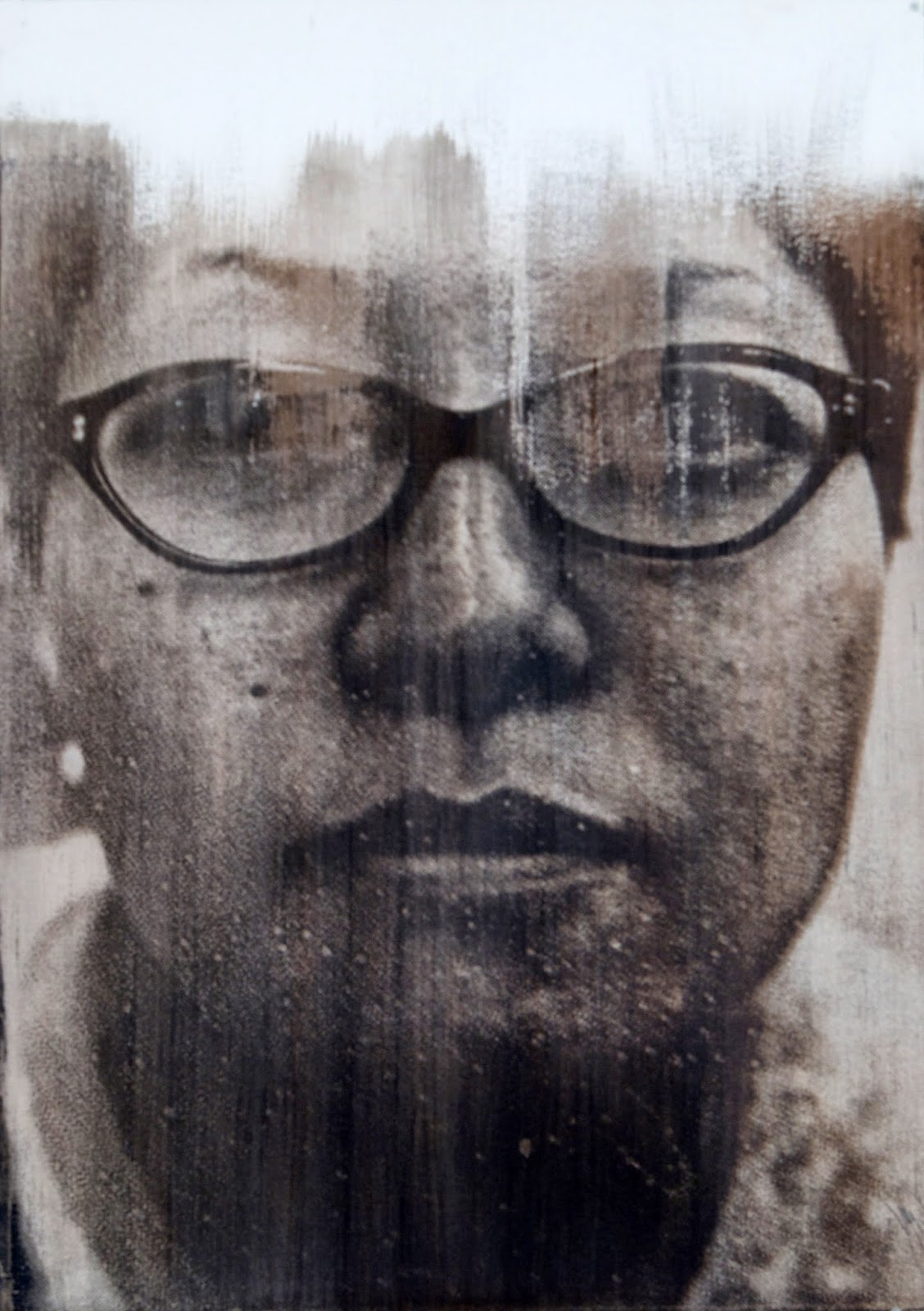
PROCESS STATEMENT EARTH PIGMENT AND CASEIN MONO-PRINTS


My materials are:


Light sensitizes casein (milk glue)
Natural dry earth pigments
Archival rag paper

My subject is:


The human face


In my working process, the image, casein and pigment become paper, the paper becomes pigment, casein and image in an attempt to bring the materials together and make them one. I work intently on each print and generally make one unique print for each subject.

In photography the print is the thing that communicates with the viewer. I researched light sensitive processes and modified a late nineteenth century casein and pigment process. I settled on this form because it is more archival than the standard rare metal process of silver gelatin print. The linking of earth and milk to make images also parallels my observation of the natural aspect of photography. In reality, basic photography is biological, not mechanical and it’s the biological link that I use as metaphor in my images. The chosen form when combined with the human face is meant to evoke a visual reference to the “Blues.” Both the musical form and my visual form are meant to be a cry of sadness and joyous celebration.

I seek to contrast broadly held public views that narrow a face into stereotype. I attempt, as an artist, to produce prints that encourage viewers to explore the dignity and nobility that can be found in the human face.


EXPERIENCE


2012 - Present


Ursinus College - Professor Emeritus

2000 - 2011


Ursinus College - Artist in residence / assistant professor

1990 - 1992


Assistant professor Tyler School of Art, Temple University

1972 - 1981


Philadelphia Evening & Sunday Bulletin / Staff photographer


EDUCATION


1990


Tyler School of Art, Temple University, Philadelphia PA

1989


Tyler School of Art, Temple University, Philadelphia, PA, MFA

1987


Tyler School of Art, Temple University, Philadelphia, PA, BFA

1972 - 81


Staff photographer, The Evening and Sunday Bulletin


SELECTED AWARDS AND HONORS


2009


4th Pennsylvania Council for the Arts Fellowship
Honickman Foundation Grant
Pew Gap Grant

1994


John Simon Guggenheim Foundation Fellowship
National Endowment for the Arts Fellowship
Pew Charitable Trust Foundation Fellowship
3rd Pennsylvania Council for the Arts Fellowship

1993


Pew Regional Visiting Artists Fellowship for the American Academy in Rome

1991


Pennsylvania Visual Artist Fellow

1988


American Artist Oral History Smithsonian Institute

1987


Future Faculty Fellowship, Tyler School of Art,


SOLO EXHIBITIONS


2013


Austin College, Dennis Gallery [ Dust Shaped Hearts]

2013


Austin College, Dennis Gallery [The Theory and Art of Magic]

2012


The Episcopal Cathedral of Philadelphia [ Earth & Dust ]

2011


Berman Museum, Collegeville, Pa.

2010


Hagedorn Foundation Gallery Atlanta, Ga. [Atlanta Black Arts Festival]

2008


Delaware Center for Contemporary Art Museum. Wilmington Delaware

2007


Gallery 339. Philadelphia, Pennsylvania


2006


Philadelphia International Airport


GROUP EXHIBITIONS


2012


After Henry Tanner: African American Artists since 1940

1999


Biographies- Philadelphia Narratives, Institute of Contemporary Art, University of
Pennsylvania, Philadelphia, PA

1996


Dust Shaped Hearts, University of Michigan Museum of Art

1995


Noyes Museum, Brigantine, NJ

1995


Dust Shaped Hearts, University of N. Carolina at Charlotte, NC


1995


Dust Shaped Hearts, Swarthmore College, List Gallery

1990


Gallery One, Western Maryland University, MD

Selections of African-American Works From the Collection, Philadelphia Museum of Art,
Philadelphia, PA

Art Now, Philadelphia Museum of Art, Philadelphia, PA

1989


Works from the Collection, Philadelphia Museum of Art, 1

1986 - 89


Philadelphia Photographers International, Tianjin, China;

1989


Temple University Center City Gallery, Philadelphia, PA


Humankind


(Main Line Art Center, February 20 through March 20, 2014
Featuring the work of Donald E. Camp, Lydia Panas and Lori Waselchuk
Curated by Amie Potsic


Curator's Statement:


Humankind presents works that uniquely address the human condition through qualities and genres inherent to the photographic tradition: social responsibility, portraiture, and the photo essay. This exhibition celebrates in depth projects that creatively engage the world of contemporary photography while deepening connections to the history of the photographic medium.

Each artist approaches their subject matter – the human face, family, and hospice -- with respect and curiosity as they harness photography’s innate talent for storytelling, confrontation, and communication.

With his forceful, yet intimate images of the human face, Donald E. Camp’s work encourages audiences to explore the dignity and nobility that can be found in each of us. Camp’s inventive photographic prints seek to contrast broadly held stereotypes and acknowledge the struggle against ignorance and intolerance as a universal one. Lydia Panas invites the viewer to look beyond the family relationships depicted in her photographs and to explore the deeper, universal questions of how we feel. Her photographs portray families of all forms in verdant landscapes while also giving subtle clues to that which lies beneath the surface in all of us. Lori Waselchuk’s photographs powerfully illuminate the ways in which our humanity percolates through the dark and light moments of our lives. Exemplified by the prison hospice program she documented, her work is emotional, interactive, and storytelling, and strives to nurture empathy in the viewer, despite our diversity.

By engaging in long-term, in-depth photographic series that give voice to the personal and universal, these artists powerfully remind us of what it means to be human, compassionate, and connected.